Key Takeaways
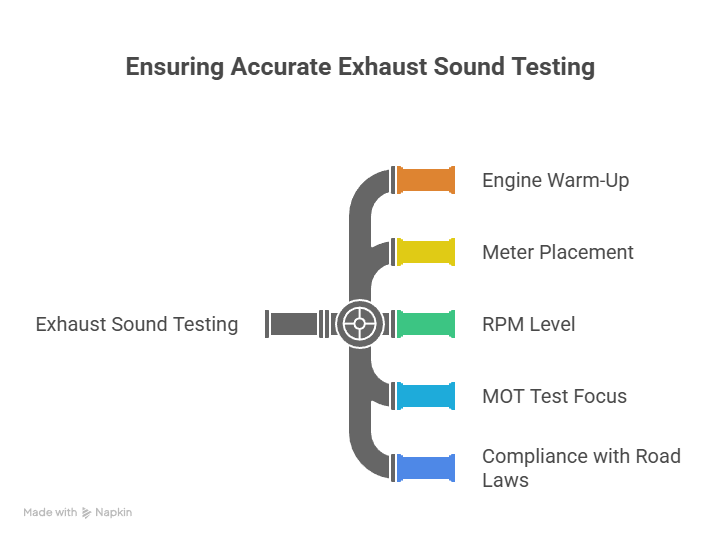
- Always warm up your engine before testing for the most accurate sound reading.
- Place the sound meter 50 cm behind the exhaust at a 45-degree angle.
- Test at half of your bike’s maximum RPM and record the highest dB level.
- The MOT test checks if your exhaust is louder than a standard system, not a specific decibel limit.
- Keep baffles fitted and your exhaust in good condition to stay compliant with UK road laws.
If you have an aftermarket exhaust or want to be sure your bike is road legal, testing your motorcycle’s noise and emissions is important. The UK has strict rules to stop excessive exhaust noise. Failing to meet them can lead to an MOT failure, fines, or being stopped by the police.
The good news is that you can check your exhaust noise level at home using a sound level meter and a few simple steps.
How to Measure Motorcycle Exhaust Noise Properly
Start by fully warming up your engine before testing. This ensures the reading reflects how your bike runs in normal conditions.
Place a sound level meter about 50 centimetres behind the exhaust outlet, keeping it at the same height and at a 45-degree angle from the line of travel. This matches the method used for MOT, ACU, and SAE J1287 testing.
Next, rev the engine to half of its maximum RPM. For example, if your bike’s redline is 10,000 RPM, hold it steady at 5,000 RPM.
Record the highest reading from the sound meter while maintaining this speed. The test should be carried out in a quiet area with low background noise, ideally outside or in an open space.
If your motorcycle has dual exhausts, test each side and use the highest reading. Most sound meters are inexpensive and easy to find online or in electronics shops.
Understanding UK Noise Limits and MOT Rules
In the UK, there isn’t a fixed national decibel limit for all motorcycles. Instead, the MOT test focuses on whether your exhaust is “clearly unreasonably louder” than a standard system in good condition. This means even if your sound meter reading seems acceptable, an exhaust marked “Not for Road Use” can still fail the MOT.
For track days, noise testing is usually stricter. Circuits often test at different distances, such as one or two metres from the exhaust, and at higher engine speeds, usually around two-thirds of the redline. Typical limits range between 95 and 105 decibels, depending on the event and location.
Following the MOT testing guide from the UK Government and the Auto-Cycle Union (ACU) sound level control standards gives you the best reference for staying compliant.
Tips for Staying Within Legal Limits
Check your exhaust regularly
Make sure there are no loose fittings, leaks, or damaged baffles that can make your bike louder than normal.Keep the dB killer or baffle fitted
If your exhaust includes a removable insert, always keep it in when riding on public roads. Removing it can easily push noise levels above legal limits.Test in an open area
Avoid garages or enclosed spaces where sound can bounce off walls and affect your readings. Test outdoors for the most accurate results.Use steady engine speed
Hold the throttle at a consistent half-redline RPM while testing to get a stable reading.Ask for professional advice
If you’re unsure whether your exhaust will pass an MOT, visit a garage or MOT station. They can compare your sound level to a stock system and give advice before your test.
Conclusion
Testing your motorcycle exhaust noise is straightforward and helps you stay within UK legal limits. A simple sound level meter, a quiet space, and the right testing position can give you a reliable reading.
Always keep your exhaust well-maintained and remember that MOT testers judge based on whether it is louder than a standard system. Taking a few minutes to check can save you hassle, fines, or a failed MOT.